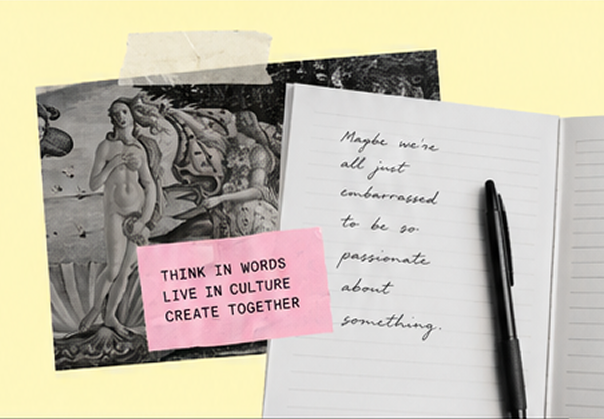
Creativity is not talent. It is attention.

People often describe creativity as if it were a mysterious gift possessed only by artists, filmmakers, designers or musicians.
But most truly creative people are not necessarily the most technically gifted people in the room.
They are usually the people paying closest attention.
They notice:
The emotional difference between two hotel lobbies,
The silence inside certain conversations,
The typography on old perfume campaigns,
The way early 2000s Apple stores made technology feel optimistic,
The way old Ralph Lauren ads romanticized American life,
The psychology behind why girls saved certain Tumblr images obsessively,
The atmosphere of a Jacques Garcia interior,
The tension between loneliness and beauty inside a Helmut Lang campaign.
Creativity is often less about producing constantly and more about developing sensitivity toward the world.
Rick Rubin once described creativity almost as a state of awareness. Susan Sontag wrote about interpretation as a way of engaging with reality. John Berger spent entire essays explaining how seeing itself is culturally constructed.
And perhaps that is the real foundation of creative thinking: Learning how to observe before attempting to create.
Most people consume passively. Creative people collect.
They collect references.
Textures.
Contradictions.
Conversations.
Emotional reactions.
Visual languages.
Social behaviors.
Fragments of atmosphere.
A creative person can walk into: A Japanese stationery store, a Casablanca villa from the 70s, a chaotic family lunch, a Miu Miu campaign, an airport lounge, a Fran Lebowitz interview, and unconsciously leave with material.
Not because they are “looking for inspiration.”
But because curiosity itself becomes their way of experiencing the world.
This is also why many creative people struggle inside environments that lack stimulation.
They are emotionally fed by observation.
And perhaps this is why journaling matters too.
Not as self-help performance.
But as a way of documenting attention.
The things you notice repeatedly usually reveal something important:
about your desires, your fears, your fascinations, your emotional patterns, your taste, your imagination.
Creativity is not only artistic production.
Sometimes it is simply the ability to recognize meaning where others see ordinary things.
And maybe that is why the most interesting people are often not the loudest or most performative ones.
They are usually the ones observing quietly.
Read more

For creative people
looking for their tribe